Sunday, March 2, 2014

AD Continued....

Consumption
Household spending in affected by:
-consumer wealth
   more wealth = more spending ( AD SHIFTS --->)
   less wealth = less spending ( AD SHIFTS <---)
-consumer expectation
   positive expectation = more spending (--->)
   negative expectation = less spending (<---)
-Household indebtness 
   less debt = more spending
   more debt = less spending 
-Taxes 
   less taxes
   more taxes

Gross Private Investment 
Investment spending in sensitive to:
-real estate rate
  -lower real investment rate: more investment >
  -higher real investment rate: less Investment <
 -expected returns 
  -higher expected returns >
  -lower expected returns <
   Expected returns are influenced by 
-expectations of the future profitability
-Technology
-Degree or Excess

Government spending:
-more gov't spending >
-less gov't spending <

Net Exports
Net exports are sensitive to 
-exchange rates and international value of $$
  -strong $ = ore imports and fewer exports = (AD >)
  -weak $ = fewer imports and more exports (AD <) 
-Relative Income  
  -strong foreign economy= more exports >
  -weak foreign economy = less exports < 
 
Aggregate Demand (AD)
Shows the real GDP that private, public and foreign sector collectively desire to purchase each possible price level
The relationship between the price level and the level of real GDP is inverse


----Three reasons AD is downward sloping----

  1. Real balances effect
  2. When the price-level is high household and businesses cannot afford to purchase as much output.
  3. when price-level is low, households can afford to purchase more output.

Interest-Rate Effect
-A higher price-level increases the interest rate which tends to discourage investment
-A lower price-level decreases the interest rate which tends to encourage investment

Foreign Purchases Effect
-A higher price-level increases the demand for relatively cheaper imports
-A lower price level increases

----Shifts in AG----
  • 2 parts to shift AD
    • change in C, Ig, G and/or X 
    • a multiplier effect that produces a greater change in than the original change in the 4 components

  • Increase in AD = AD --->
  • Decrease in AD = AD <---


GDP V. GNP

Gross Domestic Product
Total value of all final goods and services produced within a country's border within a given year

Gross National Product
Total value of all final goods and services produced by Americans in a given year

GDP
INCLUDED:
-final goods and services 
-income earned 
-interest payments on corporate bonds
-current production of final goods and services
-unsold outputs(business inventories)

EXCLUDED:
-intermediate goods
-transferred payments (public or private)
-purchases of stocks and bonds
-used, second handed sales
-non-market transactions

  • babysitting
  • own-house work or repairs
  • illegal drugs
  • prostitution
  • growing own products for personal consumption 


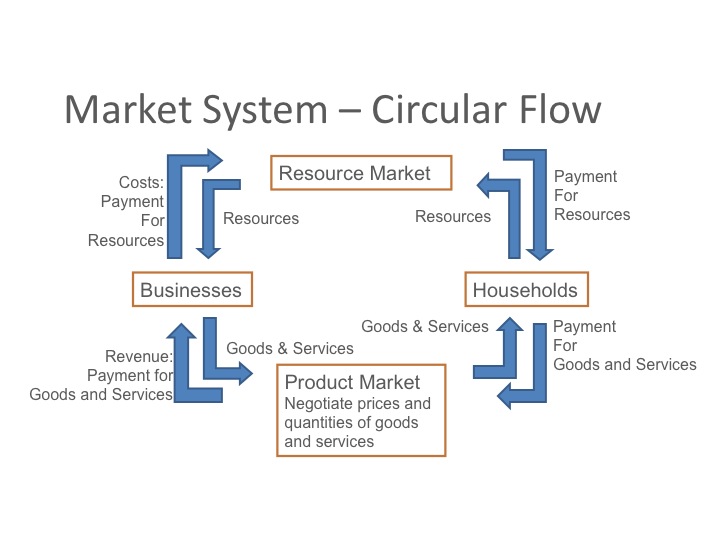
CIRCULAR FLOW MODEL

it represents the flow of money, goods and services in an economy


FACTOR MARKET                                      PRODUCT MARKET (resource market)                                    (good market)

Factors of prod                                         Goods and services are bought and 
-land                                                        sold 
-labor                                                        
-entertainment                                         
-capitol

Household: where a person or group shares an income
Firm: org. that produces goods and services for sale

GOODS AND SERVICES THAT FIRMS PRODUCE ARE PURCHASED BY HOUSEHOLDS